Chapters18
The episode
In this episode
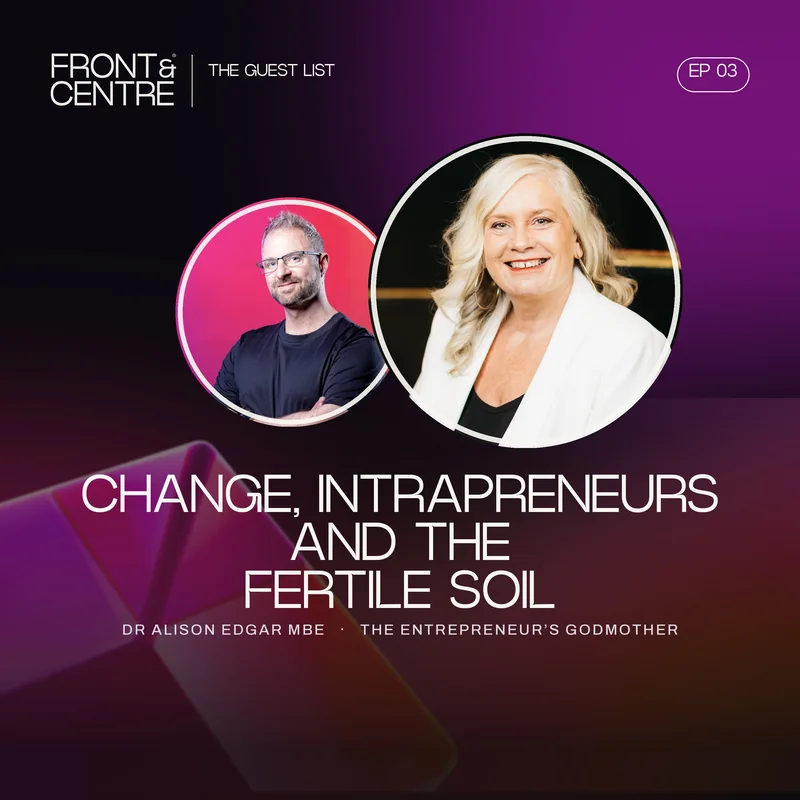
Dr Alison Edgar MBE, known as the Entrepreneur's Godmother, joins David Ventura for episode three of The Guest List. With more than 35 years across corporate, small business and startups, and clients from the FTSE 100 and Fortune 500 to EasyJet and government, Alison brings real-world experience to a conversation that opens on one big, small word: change. The genuinely big word is metathesiophobia, the fear of change, and it is what stops most organisations moving.
Alison makes the case for the intrapreneur, or everyday entrepreneur: the top performers who behave as if they run their own business inside a large organisation. The job of leadership, she argues, is to create the fertile soil, the culture and psychological safety in which a frontline idea (like EasyJet's 50p 'row one, bags only' sticker) can grow, rather than a blame culture that kills it before it starts.
Along the way: the Yellow Pages executive who said 'that Google thing will never catch on', her dad retraining on AutoCAD in the Clydebank shipyards, the three strength questions that unlock curiosity, why feedback is the breakfast of champions but you have to want to eat it, and three things to do on Monday to start building an entrepreneurial culture.
In their words
Quotable
Feedback is the breakfast of champions, but you've got to want to eat the breakfast.
Some of the best ideas are at ground level, because they're closest to the customer. By the time it reaches the C-suite, it's diluted.
You can't give someone an entrepreneurial mindset. They've got to want to receive it.
We tell ourselves we're being kind by not having the difficult conversations. It's not for them, it's for us.
He shone the mirror inward and didn't blame everyone else, because he knew he had a choice to change his life.
When we care, we'll argue. If it were your business, you'd care.
Answer key
Concepts defined in this episode
Metathesiophobia
The fear of change, and in Alison's view the real reason change stalls in organisations. People do things the way they always have because they are scared of getting it wrong, so you have to change how a team thinks about change before you can change anything else.
Intrapreneur (the everyday entrepreneur)
Someone who behaves as if they run their own business inside a large organisation. The term was coined by Gifford Pinchot III in a 1978 white paper around innovation; Alison extends it from innovation to the mindset and behaviours of top performers.
Fertile soil
Alison's metaphor for an entrepreneurial culture: the psychological safety and permission in which a frontline idea can be planted and grow, rather than being killed by a blame culture. EasyJet's 50p sticker is a seed that was allowed to grow.
Psychological safety
An environment where people can speak up, disagree and name a problem without fear of looking stupid or being punished. Pixar's brain trust, thrashing out Toy Story 2 without anyone taking feedback personally, is the example.
Locus of control
Whether you attribute outcomes to yourself or to external forces. Alison's dad 'shone the mirror inward' and retrained rather than blaming the world; an internal locus of control is what makes change and coachability possible.
Tacit approval
When a leader avoids addressing a problem, they silently approve it. Alison let a trainee turn up unkempt because she feared the conversation, and in doing so gave permission for the behaviour to continue.
The three strength questions
A simple flowchart for acting like an everyday entrepreneur: what would you do if it was your first day, if it was your best friend, and if it was your business? Each surfaces a different kind of ownership.
Marginal gains
Small, one-at-a-time improvements, like EasyJet's 50p 'row one, bags only' sticker, that compound over time into an entrepreneurial culture. You pick one problem and start, rather than trying to fix everything at once.
Straight answers
Questions this episode answers
What is metathesiophobia?
Metathesiophobia is the fear of change. Alison Edgar argues it is the real reason change stalls in organisations: people cling to how they have always done things because they are scared of getting it wrong or being rejected. The fix is to change how a team thinks about change first, from a threat to be resisted into an opportunity to look forward to.
What is an intrapreneur, or everyday entrepreneur?
An intrapreneur is someone who behaves as if they run their own business inside a larger organisation: taking ownership, working smarter not harder, building strong relationships and getting the job done. The term was coined by Gifford Pinchot III in 1978 around innovation; Alison Edgar extends it to the mindset of top performers and argues it can be taught, if people want to learn it.
What does Alison Edgar mean by 'fertile soil'?
Fertile soil is Alison Edgar's metaphor for an entrepreneurial culture: the psychological safety and permission in which frontline ideas can grow instead of being killed by a blame culture. Her example is EasyJet, whose cabin crew off-site produced a 50p 'row one, bags only' sticker that solved a real customer and operational problem.
What are Alison Edgar's three strength questions?
Three questions you can ask in any situation to act like an everyday entrepreneur: what would you do if it was your first day, what would you do if it was your best friend, and what would you do if it was your business? The first surfaces fresh eyes and accountability, the second surfaces honest, caring conversations, and the third surfaces ownership of the outcome.
Why do good ideas fail to reach the top of an organisation?
Because the best ideas are often at ground level, closest to the customer, and get diluted on the way up to the C-suite. Without a fertile soil of psychological safety and permission, people who think 'I would do that if it were my business' never act on it, and a blame culture stops the idea before it starts.
What can business leaders learn from Yellow Pages?
Yellow Pages was a profitable market leader that stopped listening to its customers and frontline staff as the digital revolution arrived, with an executive reportedly saying 'that Google thing will never catch on'. Fear of cannibalising strong print margins led it to invest in more paper directories instead of digital. The lesson: market leadership plus arrogance and fear of change is how you get overtaken, and today's version is dismissing AI.
How do you start building an entrepreneurial culture?
Alison Edgar's three Monday actions: first, listen, to your employee satisfaction data and your customer feedback; second, pick one problem rather than trying to fix everything, and treat the fix as a marginal gain; third, ask the frontline people closest to the customer for the first small step, and follow the data and trends. Then repeat, one little thing at a time.
Who is Dr Alison Edgar MBE?
Dr Alison Edgar MBE, known as the Entrepreneur's Godmother, is an author, speaker and one of the UK's leading experts on sales and entrepreneurship, with over 35 years across corporate, small business and startups. She works with organisations from the FTSE 100 and Fortune 500 to EasyJet, has advised in government, and is the author of Secrets of Successful Sales and SMASH IT! The Art of Getting What YOU Want.
What is The Guest List podcast?
The Guest List is a show on Forefront™, The Front&Centre® podcast Network, hosted by founder David Ventura. Each episode is an honest conversation with people worth putting front and centre about winning, keeping and growing the customers that matter most, and always ends with an ugly mirror moment.
The guest
About Dr Alison Edgar MBE
Dr Alison Edgar MBE
The Entrepreneur's Godmother
Dr Alison Edgar MBE, known as the Entrepreneur's Godmother, is an author, speaker and one of the UK's leading experts on sales and entrepreneurship, with more than 35 years across corporate, small business and startups. She was awarded an MBE for services to entrepreneurship and business.
She works with organisations from the FTSE 100 and Fortune 500 to EasyJet, and has been invited to advise in government. She is the author of Secrets of Successful Sales and SMASH IT! The Art of Getting What YOU Want, and a passionate advocate for neurodiversity as a strength in business.
Full transcript132 lines
I'm gonna start with a big word.
Okay.
Change. Like, I feel like sometimes change is like almost currency for people. It's like, what change can we make today? What change can I sell today? It's all about change. And, and life is changing constantly by the minute, by the hour, by the day, by the week. And in business, of course, that's no different. Like, we just have so much change going on and I think we often believe, I believe wrongly so, and I imagine you do too. That change starts in the boardroom. Like, we have decided as a board and as a company what our direction of travel needs to be and what that change is going to be. And we think we know best and we know our customers and, and. Right.
And I just can't help but wonder where the change really starts and where the value of that change and the need for that change actually, you know, where it begins. What's the catalyst? And who are the catalysts in the business? Alison Edgar, and I'm not giving your full name there. Dr. Alison Edgar, MBE. Welcome.
Thank you. Thank you for having me.
And I'm really excited. I've been so looking forward to this conversation because your journey, your history, your experience is so vast and so varied and I'm going to use a big word here, so real. And I say that really intentionally because so many people that go and support businesses and you know, please do tell us about the businesses that you support today. And I know that there are some big names there and there are also some public sector names. I know you get invited in to cabinet and to talk there. And for me, so many of the people that work in those spaces have all theories, have all of the ideas, have all of the frameworks, the models, the mechanisms, and if we're real, many of them don't have the real world experiences that I know you have.
And that's why I've been so looking forward to chatting today. I guess, you know, I've deliberately chosen not to wax lyrical about you and your introduction today because I'd like you to maybe tell us and me, you know, a little bit about yourself. First question, I guess, how does it feel having to introduce yourself and how do you typically do that?
I think when you introduce yourself, it's about keeping it quite concise and to the point. And the fact that you're talking about real world experience, I think that was, that's one of the things I would say that is my strength. I've worked in business, in corporate, in small business, in Startup arena for over 35 years. So I think I've seen the good, the bad and the ugly. And when we look at change, you know when you're saying, well, it's, you know, it's a big word, actually, it's quite a small word. The big word is metaphysiophobia.
Oh, wow.
And that is the fear of change. So when we look a lot of people, because, you know, you mentioned, oh, I think the change starts in the boardroom and I think we need direction. We definitely do. But the reason that change halts is because of this metaphysiophobia. People are scared. They want to do things the way they've always done it. They're scared of getting it wrong, they're scared of, like, feeling rejected. So when we look at this, it's about changing the way that people think about change, because a few think, I hate change, Then you feel quite anxious around it. And then sometimes that's when we see the negative behaviours, the fighting against it, the silo and the really breaking those relationships down. Whereas actually, if you can change the way that the team think and go, actually, I'm looking forward to change.
I really like change. This is going to be really exciting, this is going to be really beneficial for me and for the organisation. Then you're more excited, so you still get a bit of an adrenaline rush, but you're looking forward to it, then what you see is you, communication improves, people start to get on better, they welcome it and then really, they. They thrive during three change situations. But the main thing is you've got to change that thought process first to be able to get them to embrace change.
I want to say it again. Metaphysiophobia.
Metaphysiophobia.
I love that. That's almost today years old when I learned the word metaphysio. Metaphysiophobia. I couldn't even say the third time that.
It's funny, if I'm speaking at an event, I'll see, I'll talk about method and I'll see what is it? And most people don't really know what it is. And I'll say, right, what's a phobia? And people go, it's a fear. And I go, yeah. And I go, it's not a fear of Facebook or Instagram. And then we come to the fact it's fear of change. But I think this is one of the biggest components to being able to roll things through, to be able to achieve results.
So let me ask you about your spectrum of meta. These are phobia, then, because you've had so much change in your career, in life. I mean, if we go back, those that know you wouldn't will have heard the stories of Clydebank and where you started and where you grew up and then when you are now and getting your MBE with the late Queen, like all of that I imagine maybe I've imagined or assumed wrong. That would tell me that you are okay with change that you quite like change. Like, so what's been your experience of metaphysiophobia? Is it something you have or is it a spectrum you've learned to deal with? Like what? What's your experience of change?
I think I've learned to deal with it. I think I've come to understand that I'm okay with failure. So I think it's about feeling because, you know, if you look at doing something differently, if you're learning to play golf and you're changing your golf swing or your golf grip or you're learning to drive between a manual car and an automatic car, it's about embracing that and knowing that, well, I'm not going to be perfect at that straight away, but if I've got a strong enough purpose and a strong enough reason that I want to do that, then I'll just continue to practise it until I become good at it.
And I think that's what I was like with change, that when I look at my career path, I worked for one organisation for 15 years and at that stage, you know, I had disabled parents, I had two young children, I had like what I was working and it was really difficult because at that time, and I think this happens in our life that sometimes we've just got a lot of things going on and one more change is like just so difficult to take. So I believe that timing is everything and you know, giving yourself a break, that if you do try and do something differently and it doesn't go according to plan, you don't give up, you just get back up. And we hear people talk about resilience again, that's one of the words that's used all the time.
Oh, I need people to be more resilient. They. But actually trying to explain that because I believe that's something that's quite different to different people. So what resilience looks like to me might be different to you or to somebody else. So I think it's one of those things that resilience is the key but you've got to be able to come out of your comfort zone, not be afraid to feel. And if it doesn't go according to plan. Get back up and try again and just keep trying.
Resilience is one of those words, as you said, gets mentioned a lot. And sometimes it's the resilience against the knocks, the. The things that have gone wrong, the. The wounds that. That we might feel are inflicted by periods of quote, unquote, failure. And there is a demographic, I think, in business of people that seem to be more okay with failure. And we know, of course, of the word entrepreneur. Like the entrepreneurs of the world seemingly go hard, go fast, go at something, and if they fail, they get up, they go again, and it's all about going and going until something sticks and something wins. Most people will be less familiar, and some might not even know the word intrapreneur. And that's really your space, your world. Straight off the bat, tell me, what is an intrapreneur?
So when I did a lot of research when I started my business, I was looking at what top performers do. So when I worked in sales, I was still literally smashing targets. But I had a lot going on. I had young children, I had disabled parents, and I could still continue to hit these targets. And then I thought, right, well, what. What am I doing differently? And it wasn't just me. There was like a group of the same sort of people that were hitting target all the time. And then I took that into an extension into different departments. So what are these people doing that are kind of getting promoted or they're like not popular at work, but they get the job done? What are these people doing different to the people with erratic performances?
Because, you know, sometimes if you look at sales teams, you see erratic performance. You see that in every single department. So what was this common denominator that made the difference? And when I did some research on it, the one thing that came out from the top performers and the top performing teams was they always felt like they were running their own business, but with inside a large organisation. So when it came to making decisions about, would they form a silo, would they be falling out with their colleagues, would they be messing around with their time, Would they be productive? You know, would they be working smarter, not harder? This. This is the things that this group of people were actually doing. And then I thought, right, okay, this is really fascinating. You know, is this something that. If.
If this group of people over here are doing that, is this teachable to these people over here? And I thought, right, okay. And as soon as you want to do something and teach something differently, you turn to academia. You go, right, okay. I've done some sample research here, but has anybody done a deep dive? And there was actually a white paper written in 1978 by a man called Gifford Pinchot III.
That's a great name.
Yeah, it's a brilliant name. Him and his wife Elizabeth wrote this white paper and when we look at that, he titled it Intrapreneurship. But what he did was he sort of built it around innovation. So he was looking for people that were, like, creating new products, new services, or just doing things differently from a systems perspective or a product perspective. But then coming back to my research, I looked at the people here and the people that were more erratic performances. And it wasn't to do with innovation necessarily. It was to do with their mindset. It was to do with how they thought, how they built themselves back up again when things didn't go according to plan, how they were on top of their. Their time being thinking smarter, not harder, how they were really brilliant at forming relationships and creating great teams.
So this was where he did the research in one area, but I've extrapolated it into that. It's applicable for everyone in every organisation. And I think this is the thing that is teachable an. An educational but with actionable takeaways. So that's where it comes from originally, but it's a core component top performance.
Because if I. So if I was to just boil entrepreneurship down to a positive outcome that any business could say yes to, the question would be, do you want your people in the business to care? Or as much as. Almost as if they own it as it's theirs, do you want them to care as much as if it's theirs? Most leaders and most organisational owners would say, well, yeah, of course, yeah, that's what you're saying in terms of.
That's what I'm saying it is, yeah. And creating that sort of autonomy. So I talk about the fertile soil. So if we look, some of the best ideas are actually at the ground level in the organisation because they're closer to the customers, they're hearing the customer problems. Whereas by the time that gets up to the C suite, it's kind of got a bit diluted. They're not really getting it straight from the horse's mouth. So when we look at this, if people take this step back, so let's say it's proactive communication with a customer. If that was your business, you would be really proactive, trying to keep that customer happy, trying to retain that customer, trying to get them to refer other customers, because ultimately that's what business is.
You know, there's lots of other facets around that, but it's about making the business profitable, making the employees happier so that they do a really good job and represent the brand well. And that really is staying in profit and creating that entrepreneurial culture.
And it's like, I'm going to ask a question now, which I imagine is a question that you want all people to be asking in every business. And it's the, what would I do if this were my business? 100% Right now, what's interesting is that people don't necessarily ask that question, but they do walk around with those opinions without then the next step. So I think I get this all the time. I work with the team and I'll hear someone say, well, what I would be doing is, well, I think. And then it'll almost be instantly followed up with, well, it's never going to be that way, or it's not going to happen, or it won't change, or that all that.
What's the gap between someone knowing and thinking what they would do if it was theirs to actually acting on it and being that change that they want to see.
An entrepreneurial culture, I call it a fertile soil. So if we look at doing things differently, I'll give you an example. Right. So EasyJet are one of my clients, and I fly with EasyJet a lot because I travel a lot. And I'm quite good friends with Dame Kelly Holmes, the runner. And we do this Instagram challenge to see who can go on the flight first. Right. And I'm first. I'm first.
Yeah.
And I'm like, Kelly, you know that you've got two Olympic gold medals for running. You have got a slight advantage. No, you know, she's got this advantage, hasn't she? But the reason that we like to go on the flight first is we like to kind of get off the flight first because we're trying to get to work, really. That's the point of the travel. And it used to be on EasyJet that you would come in. My favourite seats are 1C and 1D. Right. I like an IOC and I would try and get my bag above my head, but there was no room in the locker, so I would be in one and my bag would be in 21. The flight lands. I'm trying to swim upstream to get this bag so that I can get off so that I can go to work.
So a few months ago, or maybe a year or two ago, I went on the flight and there's a little sticker above the locker bin at row one and it says, row one, bags only. And I'm like, I love that. So what had happened was I said to EasyJet, you know, one of my clients, how did this all come about? And they said, well, we had an off site and we looked at the problems we're trying to solve now. That's all business does, isn't it? Yeah. So if we. Look, the problem they had was row one were they were mad because they couldn't get their bags near them. Then what happened was they then went to the cabin crew and the cabin crew were getting it in the neck because these customers were complaining that they couldn't get hold of their bags occasionally.
Then it had a knock on effect that flights would be delayed or flights would leave late. And that's a huge problem for the whole of the airline industry. So they went on an off site, their EasyJet cabin crew or the crew went on an off site and said, look, you know, if this was your business, how would you try and solve this? What would you do differently? And one of the people in that room said, well, I'd put a little sticker up there that says, row one, bags only. A sticker costs, what, 50 pence? But it changed the game. But this is where, coming back to the gap between organisations and there might be loads of great ideas and I'd go, oh, I would do that if it was my business.
EasyJet created a fertile soil to allow that little seed of an idea to grow. And it's either going to grow or they're going to can it. And I think this is where the best ideas. If you really listen to your customers and you really listen to your frontline teams, then what can happen is the ideas will flourish or they'll flop. But you've got to give them an opportunity. You can't say, oh, we tried that in 1984 and it didn't work. You know things. The world has evolved especially around the roots of AI and how quick we can do things. Now that is where you need organisations. The thing the boardroom has to do is kind of let go of the reins and give these ideas a chance to flourish.
And by doing that, you feel valued, you feel listened to, you perform better, it's a better, you know, you're retaining your team, people are happier at work. If they're happier at work, boom, then customers are happier, they'll stay with you and the cycle goes on. And that's why I'm so passionate about entrepreneurship, because I think it's such a key component to high performing teams.
And you talked about fertile soil there. I love that metaphor, fertile soil. Because culture as a word is a bit like resilience. It just gets used and not a lot of people will really apply it to what it really needs to be. And of course, fertile soil is the, is the starting point. You need to then plant some ideas, right? Plant the seeds, and you need to water those seeds, and you need to create an environment and a process and a team of people that are prepared to do that and do that together. And so going back to the fertile soil, though, what I've just heard there with EasyJet is they allowed a space where no idea was a bad idea.
That's it. Yeah, but they were problem solving for the customer.
Right.
Another brilliant entrepreneurship example is Tony Fadell. So most people have not heard of Tony Fadell, but he was an employee of Apple. So he, Tony Fadell and his team created the ipod. So what they did was they looked at what problems they could solve, and what they were solving was the CD Walkman. You could have one cd. It's really heavy to carry around, and every time you went running, it jumped. That's a problem. So by creating the ipod, then they put a thousand songs in our pocket. But coming back to, we know Steve Jobs, Steve Wozniak, we think of them as, they're very entrepreneurial, but they gave that sort of leeway to be able to create something to put a thousand songs in our pocket. But the other main component on this is allowing people to have different opinions.
So it's when you work together, like you work together as a team and you trust the people that you work with, you feel psychologically safe, but it's okay that you have different opinions. And weren't in Apple. I wasn't there, But I would have loved to be in a fly in the wall. Somebody would go, I don't know. What do you think? Well, we have it. Silver, do you think we should put 99 songs in the pocket? How big should we make this? And there would be all these different opinions coming backwards and forwards. And different opinions are great, but this, again, comes back to this entrepreneur mindset. You're not taking it personally. You know, feedback is the breakfast of champions, but it's on your activity and what you're doing. It's not like, oh, Johnny doesn't like me. Sorry, Johnny.
But you know, that's the kind of situation, coming back to this culture, it's allowing people to have different opinions. It's not taking it personally. And it's really working together as a collective to look at what problem am I solving for my customers, what problem am I solving for my team? And how can we action that?
I love that. And so embracing the difference of opinions and pushing for the specificity of those opinions. Because if someone in that room and they were trying to come up with a thousand songs in your pocket, if someone in that room said, I don't like it, the next question should have been, what is it you specifically you don't like? Yeah, and what. Because maybe their preference is, do you know what? I just don't like anything that sounds too big. A thousand sounds like, I don't know, whatever it might have been just something they didn't like. And maybe that's something that people would have listened to. And equally, it's just an opinion that might not be the winning opinion. Yeah. But it's equally valid.
It's okay. And I think this comes back to. There's a lot of focus now in business on psychological safety. People are scared to speak up in case they look stupid or people are scared to speak up in case their boss doesn't like it, or. Yeah, and an example of this is the Pixar brain trust. So one of the things when Pixar were doing, obviously they had it very successfully done. Toy Story one, they were starting to work under a new team. And I think this is, you know, coming back to change new teams, people changing positions. It can put a lot of pressure. People are worried, they're worried for their job, they're worried that they look stupid, they're worried that they're not listened to.
So what they did was they started to create Toy Story 2 with a new team and it was not going well at all. So what they did was they put all the people, you know, the team leads in all the different sections into one room and they really did, like, I call it this, like, brain thumping around and no idea is a bad idea. And, you know, I might not like your idea. I'm going to tell you don't like your idea. I like you, but I don't really like your idea. But maybe if we tweak this idea, we could do that. And then Obviously Toy Story 2 brought us Jesse and we got 3, 4 and 5 is just out. So it's those kind of environments, that sort of think tank, without taking it personally, but there's two things.
Like, you know, you've got to make sure you deliver the feedback properly. But you've also got to give everybody that little space to be able to speak so that they can go, well, yeah, but if we made it like this, if we did it like that, oh, you know what, if we made Jesse be a cowboy, then, you know, Jesse and Woody would be, they would go on great and we could bring buzz in and all of these things. That's a culture.
It is. And it strikes me, people often say, come to me with solutions, not problems. And yet sometimes it's okay to name the problem first, like make that psychological safety, make it okay to name the problem. Something isn't working and I know we need to do something different. I might not have the answer to that yet. I just have the opinion that it doesn't work. So let's say that and let's then workshop it.
Yeah, but what happens is a lot of people focus on the things they can't control. So we know that if we look at currently there's a lot of focus on geopolitics, there's a lot of focus on UK politics, cost of living crisis, just AI everything, you know, fuel prices. And people are so busy going, oh, we can't really do much in here because, oh, there's long delivery times or there's this or there's that. And they spend so much time focusing on all these things they can't control. Whereas if you strip it back and really just listen, you know, what's going on with our customers, what can we do to help our customers keep on focusing on that and your purpose and your reason that helps drive you through those things?
Yes, there's things going on in the world, but, you know, if we all focus on that, then that's the easy route. You know, we'd rather reflect out all of these things that are controlling us rather than going, right, okay, what can we control? And really take that. And that's not new. I think most people know that, but they don't action it. And I think that comes back to fear.
And so. And I think one of the antidotes to fear is permission. And I want to come back to that in a minute before I do. You've named some really good examples and some big brands that we'll all know where this permission to have the psychological safety moments where we brain thump and knock around ideas and come up with new solutions. The way that's happened and they've embraced that change and they've came out on top after the changes happen. Of course, there are so many big brands that didn't come out on top of with change. And I know you spent quite a long time with a brand that some people now won't have heard of.
Yeah, I mean, it's. It's shocking. When I look back, the. When I applied for the job for this organisation, I was rejected because there was 100 people would apply to every role. And they said, no, you don't have enough experience. So, again, coming back to resilience and purpose, I really, really wanted to work for them. So I went away for 18 months, I got field sales experience, I came back and I knocked on the door and went, I'm here, I've arrived now. At the time when I started working for them, they were a monopoly, so were not allowed to put our prices up because we had so much market share. They won the European Quality Award twice. I mean, it was just. It was amazing. The brand was Yellow Pages. So I do thank Robbie Williams.
You know, look me up in the Yellow Pages, I will be your rock of ages. He didn't say that about Thompson Local, just saying. But what happened was they weren't listening, in my opinion, to their customers and the frontline staff that were dealing with the customers every day. And what was happening is the world was changing, the digital revolution was happening. It's the same time like 2005 is when YouTube was launched. 2005 Was when people started to turn to the Internet to be able to do searches. And what I remember being in a room in Bristol and the CEOs roadshow came town and he said, you know what, we're going to launch the direction moving forward. So without real consultation with the customers or with the frontline staff, they decided to invest 2.2 billion pounds in more paper directories in North America and Europe.
And the words that came out of his mouth because all of our customers were going, I want on the Internet, I want on the search engines. And we knew, like, Google was coming. Like, there was Ask Jeeves, there was Yahoo and Google was like the new kid on the block. And everyone's going, I want. At the top of Google, weren't the top of Google. And he said in this meeting, that Google thing will never catch on. How distant can you be? And again, I think that comes from a couple of reasons. Again, in my opinion, cannibalization companies are really scared to cannibalise because they've got a formula that works and they're not looking ahead. And what happened there was that actually the Yellow Pages was. Had brilliant Margins. They were really just great margins. So they were really reporting into the shareholders.
They didn't want the share price to drop because they knew that the margins were better in print than they were in digital. And eventually now, well, obviously there is no Yellow pages book, and all they really do is resell Google Ads. And it's shocking because I think that also comes back to arrogance in business, because if you're the market leader, you, you think, oh, that's fine, everyone's always going to come to us and there's always a new kid on the block. You know, you look at all the industries, you know, you look at Uber, you look at Airbnb, you know, there's always a new kid coming through. And that's why, really, you should be examining the, you know, what your business is and evolving to be the new kids.
Yeah, you just. That moment, because it made me wince when you said what he said, like, you know, this Google thing will never catch on, it made me wince because, I mean, hindsight's a wonderful thing, isn't it? And yet there would have been dozens, maybe even hundreds of people that heard him say that fundamentally disagreed and for whatever reason, didn't have, you know, that fertile soil, that entrepreneurial culture that gave psychological safety and permission to speak up and to challenge and to have ideas. And, you know, I kind of fast forward. In today's world, there'll be businesses up and down the land, all over the country and across the world, where some leaders will be saying, this AI fad will pass.
Yeah, that AI thing will never catch on. Who's that? Is that someone that works in accounts?
So what would you say to those organisations that, you know, and they might be denying from a place of fear, you know, maybe then denying not from a place of fear, but for anger. Maybe they just, you know, I know people that are nearing the end of their careers and are feeling like they've got to pivot and relearn things because AI is taking on this. Like, I just want to ride the next five years out. And then, like, there'll be lots of reasons, personal reasons, human reasons, why AI isn't their bag and they don't want it to catch on. We've got to accept the reality of the world we're in. Not everyone will. So what would you say to those organisations where the loudest voice is saying, nah, won't catch.
What's really interesting, because some of the biggest challenges that business have, because I'm now working with a lot of the Fortune 500, the FTSE 100. And what happens is, I ask them the challenges that they've got in their organisations. And again, when you work for an organisation, you see things through your lens, don't you? That's great being an external, because you can see the cross section and the challenges are very similar. Department silo. So we know that like sales and marketing can be each other's throats and HR and finance and, you know, people protect their hierarchies and that's where the silos form. Then what happens is the colleagues fall out. And we know that for all people, personality wise, they don't get on particularly well.
But one of the biggest challenges that we see is people really struggle to be on top of their time. And I don't even mean from a time management, but everybody's too busy, they're too busy to respond to emails, they ghost their colleagues. All of these things really struggle. So what then happens is job satisfaction drops and we know that people are like, oh, you know, the Sunday night fears. So then we can't retain staff. And that again, it affects the final results. And that's why this entrepreneurial culture is so important.
Yeah, I love that. And it's that, it's. Yeah, again, creating that fertile soil where people can challenge, can think, can speak up, can rally the troops around the things that need to be different and are real. And again, I'll come back to your. Your roots here, your experience, because the reality of those things is what shapes your view and your work today. Can I take you back to Clydebank?
Yes, of course.
Can I. Can I take you back to a time where you will have seen change happen in your family and the impact of that change from a meta. Meta. Theo. Metaphysio.
Metaphysiophobia.
Metaphysiophobia point of view and equally a. Right, we're on it, we're going to embrace this. Right. So take me back to your dad, if you can, and the story of the changes in his career that you saw.
Yeah, I think probably this has influenced me a lot and even more so on reflection. So were brought up in a high rise council flat. We never ever owned a house. My mum and dad were always brought up in social housing and then my mum was a cleaner and my dad worked in the shipyards. So about the same time as the first sort of digital revolution. So when Yellow Pages were saying that Google thing will never catch on, the equivalent of that in the shipbuilding industry was AutoCAD. So the first type of communication that was digital to be able to design the ships, because my dad used to use a rubber and a pencil and a set squared. And again, it sounds so primitive now, again, a bit like looking for a number in a big yellow book, doesn't it?
It just sounds so primitive. So what was happening was the younger generation were digital native. And again, we think this is quite new now, don't we? We go, oh, the younger generation, they're great on socials, they're great on AI, but this is, you know, we've just gone back round in a circle as far as I'm concerned. So what then happened was with change comes choice and I think this is the important thing again, looking back at the everyday entrepreneur because you make your choices every day on how you behave. So what happened was because my dad was in his 50s, he had to make a choice. He could go just, pardon, cruising to retirement, not getting bored with any of this new stuff. I'll just do what I've always done.
And we see that in business, you know, people are just, yeah, I'll just do it the way I've always done it. So he then chose to go back to night school for two years after work. So he was still working to get his qualification in AutoCAD. So he then became one of the most sought after draughtsmen in north of Scotland's England area because he could then do both. But this is the important thing because this is what I see in non entrepreneurial companies, the blame culture kicks in. So what was happening was people were going, I blame the government, I blame the management, I blame this, I blame Janet. In accounts, everybody gets the blame. And this is the massive secret accounts.
She's always in the mix, isn't she?
Massive. But this is where it's so important because we try and protect ourselves. So what we do is we go, well, I'm not going to take any responsibility for this is not me. I'm going to hold the mirror out and blame everyone else. But what my dad was, he shone the mirror in and didn't blame everyone else because he knew that he had a choice to change his life. And that's where I think I learned a lot of those core skills from my dad, that. And it's easy to blame, isn't it? Like it's the default. Oh, I blame the weather, I blame the this, I blame the that. And I think this is coming back to this entrepreneurial culture. It's, you know, people put the mission, the vision, the values on a piece of paper or on the wall?
And they go, yeah, this is our culture. But is everybody thinking like that? So I mean, it's got to start with the slt because if they don't think like that, how can you actually get the rest of your organisation to think in that way? And sometimes when I work with SLTs, they've been honest. Like there's been, you know, members of the senior leadership team have gone, yeah, I think I do the blame thing. Yeah, I think I do that. And I'm like, well, if you do that, how do you expect all the people that work for you to stay in this culture, to stay in this positive state? And they're like, right, okay, I've learned a lesson. So to me it's really honing in on really believing that, you know, the matter comes in the way, not out the way.
Yeah. And so again, the reality of that you viewed at a very young age and you saw it firsthand and I guess really saw the success of embracing that change and doing those things and looking at that mirror inwardly and not pointing it out. I know that you come at these things and we talk about mission, vision, values. They're very consultant things to say. And we go into businesses and consultants turn up and they do these things and they come up with these pithy statements and words on the wall and all of that. And you come at it from a much more pragmatic and a real point of view. And yet, of course, you are still a consultant.
So there are going to be some frameworks and some models at play, but they're questions and I'm really curious about your very simple questions that can help someone start to unpack the entrepreneurial spirit. So tell me about those questions. What are they and how do you see them play out in the organisation?
So sometimes people say to me, what do you think? Like one of the biggest life skills that you can learn. You know, if you, if there's one thing that can change your life and change other people's life and it sounds really bizarre, but it's how to master open questions. Because that's the key to leadership, it's the key to changing your own mindset. But if we look from the age of like when we're born, we start to speak, maybe age two, we're little sponges, so we're naturally really curious and we go, who, what, why, where? When, how, who, what, why, where, when how? We think in that way. And if you look at a two year old, why, why? That's how they learn.
And to me, this is a really core part of the entrepreneurial culture we want to get to the bottom of what's the problem with this and what's the problem with that? Because ultimately, business and life is just about trying to solve the problems that we've got. But when children are four or five, they go into education and depending where you're educated, for me it was like one to 32 in a classroom, one teacher, 32 kids. So you can't go, who, what, why? We win. How? Who, what, why we. When? How? Because you're going, can I? Will I. Would you like me to?
Would it?
Should it? Could it? You learn? No information. So to me, that's one of the core components is curiosity around entrepreneurship, curiosity around leadership. Because. And again, if you look at leadership, people go, do this, do that, do the next thing, but they're not finding out why that person's not doing that. They're not drilling down to find out the reason they got, oh, that person's. Oh, they're not really good at their job. Well, there's two things. It's attitude or aptitude. If it's attitude, then you can teach people on mindset, but mindset is a choice. So it's like giving someone a gift. You can't give someone an entrepreneurial mindset. They've got to want to receive it, but otherwise it's a training need. You know, like, are you training them and are you getting them to do it? Are they, you know, giving them feedback?
Because that's the breakfast of champions. And a lot of this comes back to AI, bizarrely, because people say, I don't have time for coaching in my team. I'm too busy, I'm too busy. Oh, I don't have time. Oh, I'm so overwhelmed. I've got too much going on. But a lot of that comes back that if you're using AI productively to be able to. And I'm not saying I should be right in every email and it should all be cut and paste, but there's ways that it can be utilised as a knowledge tool that buys you back time. Because the human thing will always be there in leadership. The human thing will always. And that's again, a big part of the entrepreneurial culture.
Yes, you can be innovative, but you've got to work on people and their mindset to get them to follow that mission, vision, culture. And that's where, again, really bringing that through the organisation. And I work with Some organisations that have really mastered it, they've done so well and I can feel it as soon as I walk in, you know, you're feeling it at every single level and that's something that can be taught, but you got to want to learn it.
So let's say I do want to learn it and let's say I, I hear this mission to be more curious and I think, yeah, I get that, I get how curiosity could lead to better things and all of that. And I just need a starting point. So, like going back to questions again, I know the first question and then you talk about first day, right, so tell me about the first day question and then the follow ups to that. That could, for someone that wants to be more curious.
Yeah.
Could give them a little ladder to climb, a little playbook of questions that could get that curiosity rolling for them.
So there's three things that we do to really. These are the strength questions. What would you do if it was your first day? What would you do if it was your best friend? And what would you do if it was your business? So if you ask yourself three things, like in every situation, if you sort of flowchart it and you ask one of those questions, then it's really important. So the reason that first day is important is because on your first day, you know, you might be a wee bit apprehensive. You know, I wonder if they're going to like me, wonder if this is going to happen. But you're curious and you're excited, you probably turn up on time, you probably are, you know, you're. Yeah, I know. And you're probably not that overwhelmed because you've not got any emails.
So really looking at it and we talk about. So I travel a lot and I stayed in a hotel somewhere in the UK and as I went to my room, it was actually, it was a motel, there was a chair. So there was a chair sitting there and it was dirty, it was horrible. It was covered in cobwebs. So it wasn't a chair that had just arrived, it'd been there for a while. So it kind of got me thinking, you know, that's a health and safety risk. Oh, if that is all dirty, what's my room going to be like? What's the bed going to be like? And again, you know, these are just things from a consumer perspective because there's things like that happening in business all the time. Something's a little trigger and it gets you thinking about other things.
Do you really want to be working with that organisation? So then I thought was, well, who's responsible for that chair? Whose job is it to move that chair? And I thought, is it like, the front office manager, the rooms division manager? Is it the maintenance man? Whose job is that? And I thought, I bet they're going, I'm not moving that chair because that's not my job. So we hear a lot of that, oh, that's not my job. And then the next thing is, well, we're also quite scared to step on anybody else's toes, so, oh, that might be housekeeping's job, but I don't want housekeeping thinking I'm doing their job for them, so I'll just ignore that chair. Then what happens is we habitualise. So we walk past that chair and we stop seeing the chair.
And again, we see that in organisations things aren't right and we've just become accustomed to them. So whereas actually, if that was your first day, you would notice that chair. And it's about that accountability. So who was accountable for moving that chair? Everyone. It's about open conversation and communication and saying, you know, what's that chair doing there? Who's taking that? Oh, actually, I drive past the tip on my way home. I can take that chair. Oh, great. Thanks very much. So it. That's where that. What would you do if it was your first day? You'd want to be moving that chair, wouldn't you?
Yeah.
And then the second part is, what would you do if it was your best friend? So, as leaders, I sort of reflect back on my leadership journey because I was never really trained. My background was hospitality. A lot of people aren't, and it's. That's the thing, because everybody's too busy and we sort of cut that bit because training costs us money and. But it's false economy. So I worked for Radisson in Manly beach in Sydney and I worked.
There was a young management trainee that used to work for me and he would come in and he didn't look very tidy, so he hadn't polished his shoes, he hadn't ironed his shirt and he was lovely and he was on the management programme and he had all the people skills, but he just wasn't the finished article and it didn't match the brand and I was like, oh. And I was scared. I'm like, oh, it's out of my comfort zone. What happens if it happens? If I see something and he doesn't like it? Or what happens if.
Oh.
So I put it off. And I think again, as leaders, sometimes we put off those difficult conversations or we micromanage and we, like, go in and just do that job for them. Oh, just give me your certain ally on it. And that's a wrong thing as a leader. You know, it's really addressing these conversations and for me, I let it slide for a while and it's called tacit approval. So I gave him approval to turn up unkempt because I was too scared to have the conversation. But when I had the conversation using these open questions, who, what, why, where, when, how. How do you think this affects your career? How do you think it affects the brand? How do you think it affects the customers? What do the customers think your service is going to be like?
He then came to the conclusion himself, and he now manages 200 hotels through Australasia. And this is now 30 years ago, but he still thanks me very much for having the conversation about the shoes and the shirt. So I think it's those important things that also feed into. What would you do if it was your best friend? Would you be having difficult conversations? Yes. You would?
Yeah, because those difficult, like we tell ourselves we're being kind by not having the difficult conversations and we're avoiding the discomfort for them. It's not for them, it's for us.
For us.
So we've got to put ourselves outside of that comfort zone, have the difficult conversation. Which is a gift.
Yeah, it is. I mean, feedback is the breakfast.
Breakfast of champions.
But you've got you. But you've got to want to eat the breakfast.
Right, right.
And that comes back to, again, the psychological safety that. Yeah, you people have got to feel that they're. They're gaining something from that conversation where you're like, just giving him a ball, looking and going, oh, you should be doing all that. That's quite personal, isn't it? Whereas when they come to that conclusion themselves, they're more likely to do it.
Yeah. We talked a lot about embracing change and embracing difference and difference of opinions. Of course, the people that you clash with the most often and the colleagues, let's say that you clash with the most often, the ones most different to you. The, the diagonal. Diagonal opposites, if you like. You know, think about anyone that's done personality profiling and things like that. You look at the. The red energy versus the green energy, the blue versus the yellow. You know, someone that's logical versus someone that's empathetic, all of those diagonals. And of course, they are continuums, they're spectrums you can be paradoxical, you can be both opposites can attract, do attract. How do you move from diagonal repellents to diagonal attractions? If that's a, you know, I think.
It's known there's self knowledge on how those behaviours work.
Right.
And I think to me it's the basic foundation of great teamwork. You've got to know your strengths, your weaknesses, what you do in difficult situations, what you do on the day to day. So again, the good day and the bad day, you've got to understand why your colleague behaves in that way. And it might drive you absolutely bananas, but it's really adapting to them because what we hear this phrase all the time. Oh, I was brought up to treat other people how I want to be treated. Well, don't, because you double down on your bad behaviours and that just winds them up. That grates on the nerves and that's why the colleagues fall out. So if that was your best friend, you'd find a way to get on with them. You would understand why.
You know, again, if you look at somebody that's maybe a high blue behaviour, you know why they're like really precise in everything they do, they need that detail. And you're waltzing in 10 minutes late, talking about the weather, it's not going to work. And again, coming back to the sort of psychological safety, I think one of the things is like red leaders with green behaviour types because they're like, do it now. When am I getting this? They're not actually curious as to what's going on with that person.
And you know what, the curiosity doesn't have to lead to agreement either, does it?
No, I think it shouldn't. I think it's really. If we look at some of the models, theory models on change and high performing teams is around this positive conflict. It's great. You know, we spoke about it earlier with Apple when they were putting the ipod together. Oh, I think it should have run 99 songs. I think it should be a thousand songs. I think it should be silver. I think it should be this. I think it should fit in your pocket like this. I think we should have a squirrelly screen. Great, bring it on. Because it's those different opinions. You probably haven't thought about some of that detail, but somebody else in your team has because they're like, well actually if it's this big, you can't fit your finger in to make it about all of these things.
But this is where inclusivity in entrepreneurship is really important, I think a massive thing on inclusivity around the innovation and from every angle of diversity and inclusion. It's so important. Especially obviously I'm neurodiverse. Sometimes we focus on the negatives of neurodiversity rather than the positives that they bring. And some of that is just genius thinking. But sometimes, again, people perceive us as being a bit stupid because we struggle with reading, writing and spelling. But dyslexic thinking is a massive solution.
Into entrepreneurship and, and all versions of difference. Like, so, you know, neurodiversity as a concept is the diversity, the difference in the neurology. And of course that means it's an everyone in the population thing and not just those that are divergent further away from the typical.
Yeah.
And it's something that, it's embracing difference and it's knowing that those differences really matter and can make a huge difference. And, and I'm curious again, you know, when it comes to this sort of embracing of change and how we create the culture and give people permission to embrace that change and challenge that trend and the positive conflict. So positive conflict feels difficult and isn't because we just have to go. It's okay to disagree.
Yeah.
And where we, I think, argue the most, have the most conflict in life, typically is with people that we love. And the reason for that is because we care enough about the thing we want to argue about. Right?
Yeah.
So we, when we care, we'll argue. If it were your business, you'd care. Yeah. And your third question, if it were your business. Yeah.
What would you do if it was your business? So to me, you should be asking that every single day, especially when you are moving into difficult conversations or conflict or dealing with customers or anything at all. And even like starting your day in an organised way, if that makes sense or being on time or like anything like that. What would you do if it was your business? And the answer is I would turn up on time. I would be, you know, organised, I would be looking towards like, what is that? What problem am I solving? Also, is this business making money?
Because if you don't make money in your business, so you'd be looking at a cost centre of yourself to see like, you know, not just you don't have to work in sales to be looking at the costs and profits, but as an organisation, how would I be doing that? And it comes back to the three challenges. Department silo, colleagues fall out, people get overwhelmed, job satisfaction gets Low, then we turn and that affects the bottom line. So it's all of those things in those actions. Would you be falling out with Janet with accounts? No, you wouldn't. Would you be turning up on time? Yes, you would. Would you be ghosting? Like, this is one of the big things. There's so much ghosting goes on between colleagues, and it's to do with the difference of priorities.
So I created this thing called Alison Edgar's Big Balls. So I talk about the basketballs, the tennis balls and the ping pong balls. And I've actually got the trademark for big balls. That did set a lot of red flags off at the trademark office, but I got it. And if you look. So say, for example, coming back to the siloing, you might need a purchase order from finance to run a marketing campaign. The marketing campaigns got to launch at a certain time. So therefore it generates sales leads. So therefore it hits sales targets on a quarterly basis. But if the start point of the finance department not giving you the purchase order because that's. They're treating that as a ping pong ball because they're doing it in a linear list, then you're going to miss the campaign. So marketing, then that's their basketball.
They're getting all flustered. They're blaming this department. And then sales are going, well, I'm not getting any leads in. And marketing's like, Scott, because I never got this. And again, the disparity of the balls creates this blame culture. And it's the blame culture that creates this toxic environment to work in which affects all of these things, which are not entrepreneurial.
Yeah. We think it's the right thing to do to stay in our lane. And actually we're all running a race together. And sometimes it's a relay race where we pass the baton on. Sometimes it's actually a race where we all need to get over the line at the same time. Whatever. We might be different lanes, but. But we're all in the same race.
That's the thing. It comes back to that responsibility versus accountability. Oh, I'm not responsible for the purchase order. Oh, no, I'm not responsible for the marketing campaign. Oh, no, I'm not responsible. That's Jenny, that's James, that's John, that's somebody else. That's Janet in accounts. But really, by going, okay, we're actually all, you know, this is my business. So therefore I'm not jumping on a different lane. I'm communicating with you. So I can help you create the. The race. Really, when there is because when it.
Is my business, obviously, there's a very, very clear outcome result roi that is personal. It is a number on a spreadsheet or in a bank account. And it's personal because it's my business and I'm attached to that at whatever portion of that is mine. Right. Often the personal motivational outcome, feeling the emotional outcome is a higher reward, right?
Yeah, definitely. I mean, I think there's different ways to. To monitor businesses, aren't there? So obviously you've got your financials, which are really important, because without those, you don't have the business. You've also got the customer satisfaction side of things, but where sometimes it gets missed is the employee satisfaction.
Yeah.
So if you look at the cost of recruitment, you look at the churn and you look at all of those things. Actually having employees that want to, like, literally bounce into work, not have the Sunday night dreads, want to communicate that stuff's priceless happiness at work. You know, I wrote the book Smash it. And people say to me, what does that actually mean, Alison? Well, it means something different to everyone. Different to you, different to me. But ultimately, to smash it is to be happy. And you're a 360 of a person. You know, if you're miserable at work, that transfers to home, doesn't it? It's got a knock on, because we're a 360 of a person and vice versa. You know, if you're not happy at home, can have a knock on at work.
But if you've got a supportive team at work, they'll help you to be able to perform because you perform as a team, not as an individual. And coming back to your race and staying in your lane. You know, we know that the Brownlee brothers is a great example of that, isn't it? Like, they were there as two brothers as a team. Like, one's racing ahead and the other one's, like, hurt his leg, then he's holding him back and he's pulling them across the line. That is great teamwork. We're not all going to be 100% fit all of the time, but understanding your team, working with them, and you know, I don't even mean carrying them from a work perspective, but, you know, working together to go. Right, okay, well, if you do that, I'll do that. We can do this. And that's communication.
Yeah. There'll be businesses and leaders that are watching our conversation today and hearing what you're saying and thinking, I wish my people had an entrepreneurial mindset. They'll be Thinking to be able to create that, I've got to do something. I've got to create the fertile soil in the organisation that those ideas can get planted and they're comfortable and there's psychological safety for them to grow. We've got to embrace change and remove the metathesophobia. These are phobia. I will get it right. Eventually. There'll be businesses that know this is right and equally will be thinking pragmatically, what's the action on Monday that I need to take? I'd like you to maybe just give viewers three things that they can do on Monday that would start the process of creating an entrepreneurial culture.
So the first thing that they could do is you have to listen, right? Listen. Have a look at your employee satisfaction results or the feedback from your team. Have a listen to the feedback from your customers. And again, the EasyJet is a brilliant example. Those were two things that have been kicking around for a while and you're not going to go and change everything. The little sticker above bin 1 was a marginal gain. So really work out. You know, you might have loads of problems with your employees, you might have loads of problems with your customers. You know, you pick one and you start with one. You know, don't. Don't get too embroiled in loads of them. And then you go, right, what's the first thing that we can do towards that?
To be able to resolve it and ask the people at the bottom level that are dealing with your customers or the people that are dealing with the team, and you follow the trend. I think data and trends are incredible in this space. Then what you do is that, again, it's like the marginal gains, you know, we know from the marginal gain stuff, oh, they change the washing powder or they do this or they, you know, have a cup of tea or whatever. It is just one little thing at a time and then that's how you move towards that entrepreneurial culture.
And it is a movement. And thank you for sharing the movement with us today. I know you're very passionate about this and the clients that you work with join your movement and are making big, not just marginal gains, big gains in creating those. Those cultures. There's so much more that I'd love to hear from you, but we're out of time. Thank you so much for joining us and thanks for talking about the entrepreneurial mindset.
Thank you for having me.